The Role of Thermal Balancing Valves in Legionella Prevention in Healthcare

Legionella control is only as effective as the weakest part of the water system. When circulation and temperature vary across complex healthcare networks, how can thermal balancing valves support in maintaining control? 

Author: Charlotte Dale

Charlotte Dale

Legionella Remains an Active Healthcare Risk

Legionnaires’ disease is a potentially fatal form of pneumonia caused by Legionella bacteria. Infection occurs predominantly through the inhalation of contaminated aerosols, such as fine droplets produced by showers, sprays and other water outlets. Infection can also occur through aspiration of contaminated water, which the World Health Organisation (WHO) identifies as a particular concern for susceptible hospital patients.

The latest UK Health Security Agency annual statistics recorded 463 confirmed cases of Legionnaires’ disease in England and Wales during 2024. Of these, 63.9% occurred in people aged 60 years and over, and the estimated case-fatality rate was 2.8%. 

These figures are particularly relevant to healthcare. HSG274 Part 2 identifies increasing age, underlying illness and impaired immunity among the factors associated with increased susceptibility. Acute hospitals can therefore combine complex water systems with comparatively high numbers of vulnerable occupants. 

For this reason, HSG274 explicitly identifies healthcare premises as higher-risk environments and refers healthcare projects in England to HTM 04-01, and WHTM 04-01 in Wales, for specific water-system requirements.  

The challenge for designers is that Legionella occurs naturally in water, meaning the objective is not simply exclusion but preventing engineered water systems from creating conditions in which bacterial populations can proliferate. 

Temperature and circulation are fundamental to that control. 
Why Temperature and Circulation Matter

The WHO identifies 20°C to 50°C as a temperature range in which Legionella can grow, with approximately 35°C considered optimal. ACoP L8 similarly identifies temperatures between 20°C and 45°C, alongside stored or recirculated water, stagnation and deposits such as scale, rust, sludge and biofilm, as factors capable of increasing risk. 

Temperature control therefore remains a primary method of controlling Legionella within hot and cold water services. 

HSG274 states that hot water should be stored at least 60°C and distributed so that it reaches 50°C within one minute at outlets, increasing to 55°C within one minute in healthcare premises. Circulating hot water loops should also achieve return temperatures of at least 50°C, or 55°C in healthcare premises. For healthcare premises in England, HTM 04-01 sets the design and operational requirements that apply alongside these values. 

The difficulty is maintaining those temperatures across an entire system. 

A large healthcare domestic hot water (DHW) network may contain principal, subordinate and tertiary loops serving multiple floors, wards and outlets. Pipe lengths, pressure losses and demand profiles vary throughout the system and, without effective hydraulic balancing, water will naturally favour the easier flow paths. Circuits close to the pump may receive more flow than required, while hydraulically remote branches receive insufficient circulation. 

A system can therefore have adequate heat generation at plant level while still failing to maintain the required temperatures throughout the distribution network. 

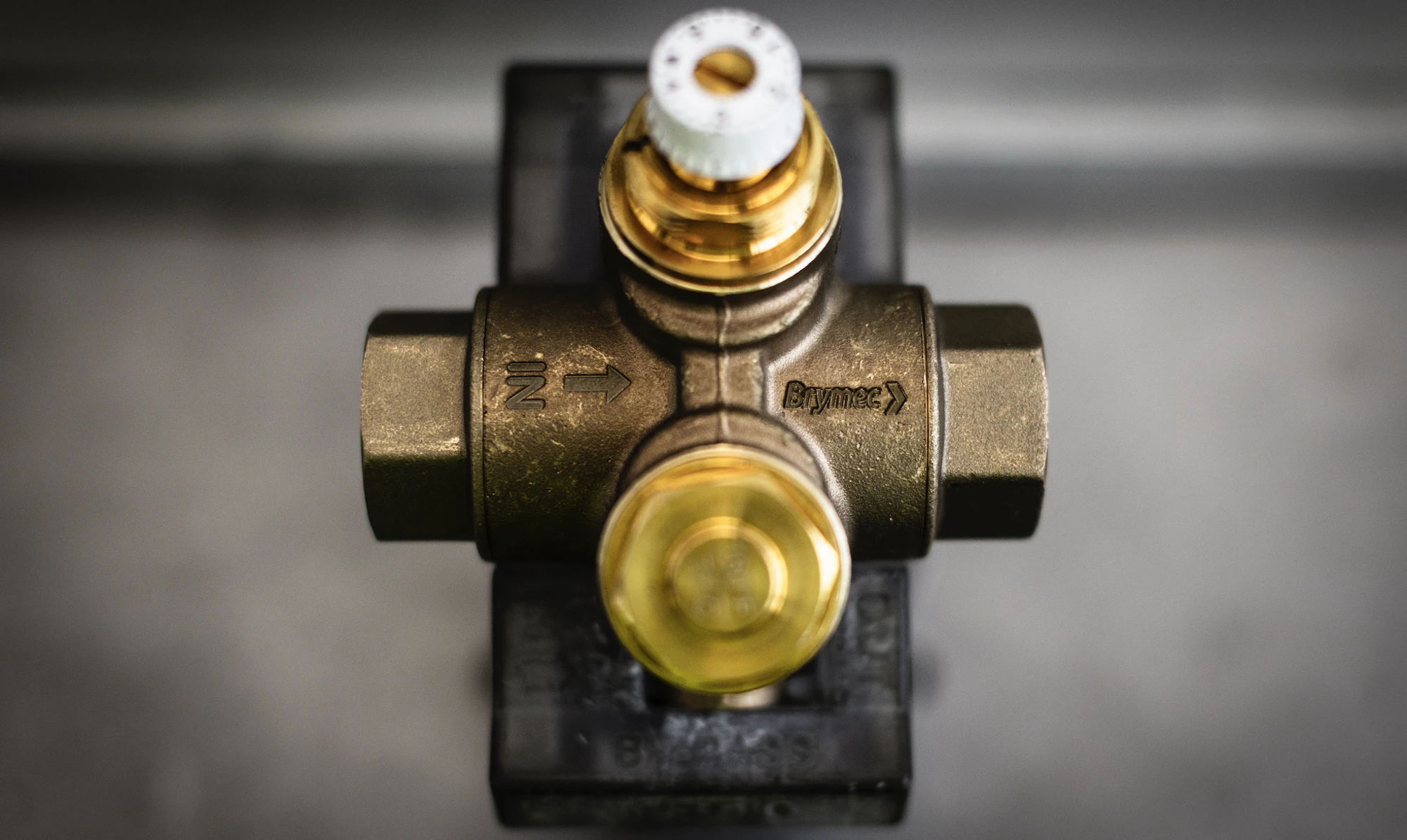
brymec thermal balancing valve

Circulating pump design and the correct commissioning of balancing valves are key issues to ensure flow throughout all parts of the hot water system, particularly the hot water return legs. Balancing the hot water system flow and return circuits is critical to avoid long lengths of stagnant pipework that is likely to be at a lower temperature

HSG274 Part 2, paragraph 2.37

This is the hydraulic problem balancing valves are designed to address: not the temperature at which hot water is generated, but how effectively circulation is distributed throughout the system. 

Where Thermal Balancing Valves Fit into the Strategy

A traditional manual balancing valve establishes hydraulic resistance during commissioning. Once set, that resistance distributes flow according to the original system design. 

In contrast, a thermal balancing valve (TBV) responds to the temperature of the circulating water. 

The Brymec TBV uses a thermostatic sensor to continuously modulate the valve opening relative to the selected temperature setting. When the temperature of the circuit it serves (typically a riser or branch return) falls below target, the valve allows greater circulation. As the branch approaches its set temperature, the valve modulates towards its minimum-flow condition. 

Cooler branches can therefore receive proportionally greater circulation while branches already achieving temperature are restricted. This creates a dynamic relationship between temperature and flow rather than relying solely on hydraulic resistance established during commissioning. 

For healthcare projects where DHW demand changes by ward, floor, occupancy and time of day, temperature-responsive balancing allows the circulation system to react as thermal conditions change. 

It is important, however, to define the role correctly: a TBV does not, by itself, prevent Legionella. 

ACoP L8 requires a system-level approach addressing temperature, circulation, stagnation, cleanliness, operation, maintenance and other conditions that can support bacterial growth. TBVs contribute to this wider strategy by helping maintain the circulation and return temperatures required across the DHW network, reducing the opportunity for hydraulically disadvantaged branches to remain at temperatures favourable to proliferation. 

Because the TBV only senses temperature locally at the valve, it should be fitted at the end of the branch return, close to the return main, with the setpoint chosen relative to the system flow temperature and required return temperature. A TBV cannot compensate for an undersized circulation pump, inadequate system flow or poor insulation. 

TBVs should also not be confused with Thermostatic Mixing Valves (TMVs). A TBV regulates recirculating flow according to temperature, whereas a TMV blends hot and cold water close to an outlet to control delivery temperature and reduce scalding risk. 

That distinction is especially important in healthcare. HSG274 identifies a scalding risk above 44°C and HTM 04-01 calls for TMV3-approved valves where vulnerable patients face significant scalding risk. However, mixed water downstream of a TMV can provide temperatures favourable to Legionella, which is why TMVs should be positioned close to the point of use. 

The design objective is therefore twofold: maintain sufficiently high temperatures within the distribution system for microbiological control, while reducing temperature locally where the risk assessment identifies a need for scald protection. 

Metal pipes in thermal insulation winding on the ceiling of an industrial enterprise

Minimum Flow, Stagnation and Thermal Disinfection

Temperature cannot be considered independently from water movement. 

ACoP L8 identifies avoidance of stagnation as a core control measure because stagnant water can encourage biofilm growth. HSG274 similarly requires water systems to be designed so that flow occurs through all parts of the system. 

The Brymec TBV therefore modulates rather than acting as an isolation valve. Above its normal balancing setpoint, it maintains a minimum-flow characteristic instead of completely closing the circuit. Technical data specifies a Kv min of 0.2 against a maximum Kv of 1.8, allowing circulation through the circuit to continue. 

This does not eliminate every stagnation risk downstream. Deadlegs, redundant pipework, little-used outlets and peripheral branches must still be addressed through appropriate design, removal or flushing. HSG274 states that infrequently used outlets should generally be removed where practicable or included within a flushing regime, normally at least weekly, with more frequent flushing potentially required for high-risk healthcare populations. 

The same principle applies during thermal disinfection. 

Thermal disinfection is a remedial or contingency measure rather than routine control, and it creates a scald risk at outlets, so occupied healthcare areas need controls in place while it runs. 

HSG274 describes thermal disinfection as raising the hot water system to a temperature at which Legionella will not survive, circulating the elevated-temperature water throughout the system and flushing outlets for the required period. Under the HSE procedure, the calorifier must remain sufficiently hot that outlets do not fall below 60°C, with each tap or appliance run sequentially for at least five minutes at full temperature. 

Successful disinfection therefore depends on elevated-temperature water reaching the relevant circuits. 

Brymec’s TBV range supports this in two ways. The Brymec TBV 31000/31001 incorporates a second thermostatic sensor associated with an automatic disinfection bypass, with the valve specification setting the disinfection temperature at 70°C. During elevated-temperature operation, the bypass allows higher-temperature water to circulate through the circuit. 

The Brymec TBV 31002/31003 uses an actuator-controlled arrangement instead. When connected to a suitable control system or BMS, the bypass can be opened during a disinfection cycle, allowing the process to be managed against both temperature and duration and integrated into the wider building management strategy. 

The Golden Thread: Design, Monitoring and Responsibility

Effective Legionella control starts before commissioning and continues throughout the operating life of the building. 

Paragraph 75 of ACoP L8 places duties on designers, manufacturers, importers, suppliers and installers of water systems that may create a Legionella exposure risk. So far as reasonably practicable, systems must be designed and constructed to be safe and without risks to health when used at work, with users provided with adequate information about risks and necessary control measures. 

For consultants, this means considering Legionella risk while determining the distribution architecture, pipe sizing, circulation strategy, balancing method, deadleg management, monitoring provisions and maintenance access, rather than attempting to address these issues after the building becomes operational. 

Performance must then be demonstrable. 

HSG274 requires circulating hot water returns at principal loops to be monitored monthly and subordinate loops quarterly, ideally on a rolling monthly basis. In healthcare premises these returns should achieve at least 55°C, with tertiary loops serving high-risk users potentially requiring additional monitoring. 

The Brymec TBV incorporates a ½-inch drywell capable of accepting a temperature probe with an appropriate adaptor, enabling remote monitoring during normal circulation and disinfection cycles. On the actuator-controlled TB50, this can be combined with BMS control of the disinfection bypass. 

This contributes to the wider evidence required under ACoP L8. Records should capture inspections, tests and checks, their dates and any remedial action taken, with monitoring and inspection records retained for at least five years. 

For consultants, the objective is therefore not simply to design a system expected to remain at temperature. Legionella control is not achieved by specifying an individual component. It is achieved by designing a water system in which temperature, circulation, turnover, monitoring and operational control work together, and by ensuring the evidence exists to demonstrate that they continue to do so. 

Get In Touch!

For help specifying thermal balancing, monitoring or disinfection on a healthcare project, contact the Brymec Technical or Specification team for project-specific support.